
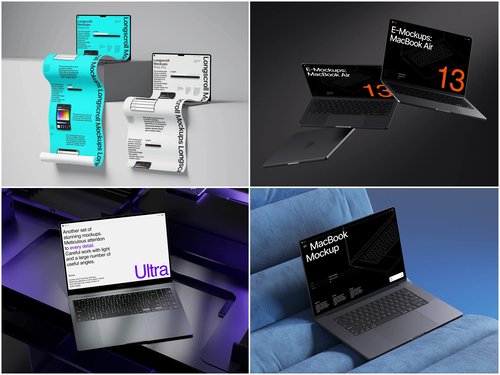
There’s a moment every freelance designer knows well. You’ve spent hours crafting something genuinely brilliant — a dashboard interface, a sleek landing page, a branding system that practically breathes — and then you slap a flat screenshot into your proposal PDF and watch the client’s eyes glaze over during the call.
The work is great. The presentation isn’t. And in the world of freelancing, presentation is half the battle.
Here’s the uncomfortable truth: clients don’t buy design. They buy confidence. They buy the feeling that their investment will pay off. And nothing builds that feeling faster than showing your work the way it was meant to be seen — alive, in context, on a real device.
That’s where the laptop mockup quietly becomes one of the most powerful tools in a freelancer’s arsenal.
Why Perception Drives Pricing
Before we talk tactics, let’s talk psychology.
When a potential client looks at your portfolio, they’re not consciously evaluating kerning or grid systems. They’re asking themselves one subconscious question: Does this person do work that looks like it costs what they’re asking?
A flat PNG on a white background whispers “student project.” A beautifully rendered laptop mockup on a marble desk, with soft shadows and perfect lighting, says “professional studio.” Same design. Completely different story.
Freelancers who understand this don’t just use mockups to make things look pretty. They use them strategically — as a psychological lever that shifts perception before a word is spoken.
The Real-World Pricing Impact
Let’s be specific. Imagine two designers pitching the same web project:
- Designer A sends a PDF with flat screenshots and a rate of €60/hour.
- Designer B sends a proposal featuring cinematic laptop mockups, contextual lifestyle scenes, and a rate of €95/hour.
Both designers might have equal talent. But Designer B has shown their value. The mockup isn’t decoration — it’s evidence.
Surveys of freelance designers consistently show that those who invest in high-quality presentation tools charge 30–50% more than peers with comparable skills but weaker portfolios. Mockups are a direct line between your effort and your invoice.
Real Examples: Laptop Mockups in Action
Theory is one thing. Let’s look at how real freelancers are putting laptop mockups to work right now.
Portfolio websites. A UX designer specializing in SaaS products uses full-screen laptop mockups as hero images on her portfolio. Instead of galleries of flat screens, visitors land on a cinematic scene: a sleek MacBook on a minimal desk, her dashboard design glowing on-screen. Bounce rates dropped. Inquiry rates tripled.
Client proposals. A brand designer in Amsterdam now builds every proposal around device mockups of the early concepts. Rather than describing what the site will feel like, he shows it — in context, on a screen, with real visual weight. Clients routinely comment that they “could already picture it live.”
Case studies. A freelance developer with design skills uses laptop mockups to frame before-and-after comparisons in her case studies. The mockup creates a neutral, professional canvas that makes the design transformation dramatically visible.
Social media content. Posting flat design screenshots gets ignored. Post the same design inside a well-lit laptop mockup with a clean background, and engagement increases noticeably. The mockup creates the kind of scroll-stopping visual that builds an audience over time.
Practical Ways to Raise Your Rates Using Mockups
So how do you actually translate better visuals into better pay? Here’s a direct approach:
- Anchor your portfolio around mockups, not screenshots. Every major project should have at least one strong device presentation. Make it the first thing people see, not an afterthought.
- Build mockup-first proposals. When pitching a new project, drop early concepts into mockups before the client has agreed to anything. It shows seriousness, professionalism, and vision.
- Create a signature style. Choose mockup aesthetics — minimal, lifestyle, dark, editorial — that are consistent across your brand. Visual consistency signals that you’re not a freelancer, you’re a studio.
- Use mockups in testimonial requests. When asking happy clients for reviews, share a mockup of their project alongside the request. It reminds them of the quality, and the visual often ends up shared on their own channels too.
Laptop Mockups on ls.graphics: A Cut Above
Not all mockups are created equal, and serious freelancers can tell the difference — but more importantly, clients can feel the difference, even when they can’t name it.
The laptop mockups available on ls.graphics are genuinely in a different category. The rendering is ultra-realistic: light falls the way it actually falls, shadows have depth and nuance, reflections behave like real glass and aluminum. These aren’t renders that look “good for a mockup.” They look like photographs.
What makes them especially valuable for working designers:
- Organized, well-labeled layers — swap your design in within seconds, no guesswork required.
- Multiple angles and perspectives — front-facing, three-quarter views, top-down lifestyle scenes, giving you flexibility for any presentation format.
- Multiple color styles — silver, space gray, dark, light, letting you match the mood of each project rather than forcing one aesthetic on everything.
- Minimalistic, stylish compositions — clean backgrounds and thoughtful staging mean the design stays the hero, never the mockup itself.
The ease of use is real. Drop in your artboard, adjust a shadow if needed, export. For freelancers working across multiple clients and tight deadlines, that efficiency compounds fast.
Conclusion
Raising your rates as a freelancer isn’t just about working harder or adding new skills to your toolkit. Sometimes it’s about showing what you already do — properly.
A well-placed laptop mockup transforms your work from a file into a vision. It shifts the client’s perception from “this is what the designer made” to “this is what my product will look like.” That shift is worth real money.
Invest in quality tools, build consistent presentation habits, and let your visuals do the selling before you say a word. Resources like ls.graphics exist precisely for designers who take this seriously — and the freelancers who use them charge accordingly.
Your talent was never the problem. Now make sure your presentation matches it.